
 Retour au panier

 Contact


As seen in previous episodes… the very first diamonds were found in India.
✨ Then kept in their rough form, they were considered talismans: it was believed that they protected their owner and that they lost their powers if they were cut.
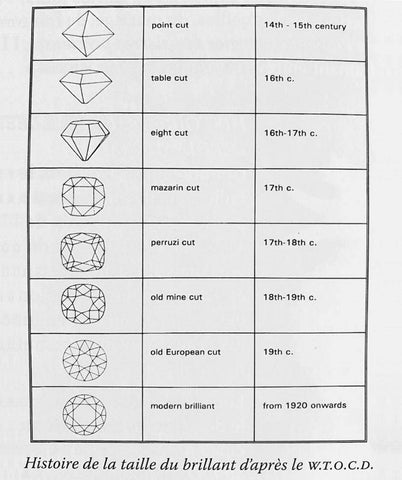
✨ The true cutting of diamonds began in the Middle Ages (14th century), with a very superficial polishing of the stone to give it a little brilliance. The "cut" followed the natural shape of the diamond: the faces were flattened. This was called the "point cut."

✨ In the 15th century, it was discovered that diamonds could be cut with their own dust: the thick table cut became the first true diamond cut. The top of the rough diamond's "pyramid" disappeared, and the edges began to be faceted. This was called the "French or Table cut."

✨ A new cut developed in the 16th century. It was the "eight-eight" cut: 1 table and 8 facets.

✨ Then, the cut was improved: 9 facets were added to the "crown" of the diamond: that is, the part between the "table" and the "culet" of the diamond. With the Mazarin cut, diamonds began to sparkle.

✨ In the 16th and 17th centuries, the rose cut, a dome adorned with 24 facets, was also developed by Indians, who even today are the only ones in the world to master this expertise.

✨Around 1700, the "Peruzzi cut" appeared: it is the ancestor of the modern brilliant cut, but it still follows the natural shape of the rough stone, being more square, or "cushion," than round.


✨ Around 1750, King Louis XV commissioned his jeweler to create a diamond cut in the shape of the mouth of his mistress, Madame de Pompadour: the "marquise" or "navette" cut was born!

✨Then, the Peruzzi cut evolved to include 58 facets, like modern cuts; it was fashionable from 1825 to 1900. The Anglo-Saxon world called it the "old mine" cut, while French speakers referred to it as the "cushion cut."

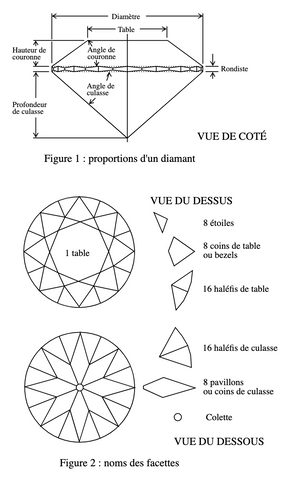
✨In 1919, the round brilliant cut, the "modern" cut, was invented by a mathematician, Marcel Tolkowsky. He published the ideal proportions for a diamond. This cut had 58 facets and is considered the basis of the "modern cut" which would be progressively optimized in the following decades, notably with the advent of laser cutting, popular since the 1980s.

So, did you know?
More next week!
1 comment
Super article ! Très intéressant de voir l’évolution de la taille des diamants à travers les siècles 😳
Leave a comment