
 Back to cart


 Contact


The Origin of the Engagement Ring
Giving a piece of jewelry to one's fiancée is a very ancient custom. The first engagement rings date back to Roman times. While traditions have evolved over centuries and across geographies, one thing has remained constant: an engagement ring must be original and personalized!


Egypt, Ring Finger, Vein of Love, and the Popularization of the Diamond to Adorn the Ring
It all began in Egypt. Often made of agate (a fine stone) or gold, the tradition was to wear it on the ring finger of the left hand. The belief was that the "vein of love" connected this finger directly to the heart!
In Roman antiquity, men and women exchanged a simple iron or gold band without a precious stone. Different from the solitaire diamonds we are used to seeing today: it was common to receive a simple iron ring, a symbol of endless love. This tradition continued until the Middle Ages.
In 1477, the engagement ring evolved: set with diamonds, it was offered to Mary of Burgundy, engaged to Archduke Maximilian of Austria. Set with diamonds forming an M, it transformed the tradition of engagements: the diamond, chosen for its exceptional hardness, became the symbol of fidelity.
Increasingly Elaborate Stone Work to Ensure Greater Originality of the Ring
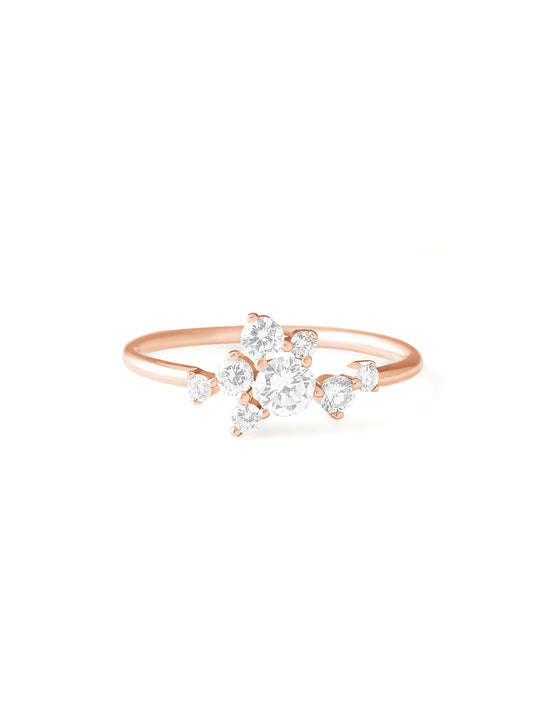
In the 18th century, wedding rings became increasingly elaborate, and the use of diamonds became common. They were adorned with several stones, and often featured symbols related to love, initials set with diamonds, or fine pearls. Some are now known as "Pompadour" or "Toi et Moi"...
Economic expansion and the discovery of mines then marked a new stage in the quality of rings: diamond cutting became more refined, settings became lighter, and stones shone even brighter.
In today's jewelry, solitaire, Pompadour, Toi et Moi, and Marguerite shapes are still present. They have crossed centuries, and we continue to draw inspiration from them today, either by preserving their structures or by revisiting them.

The Quest for the Personalized and Original Ring Cultivated by Kings and Queens
Throughout history, kings and queens sealed their engagements with a ring that used family jewels: they would assemble and disassemble family jewelry according to their desires and fashion. For example, future kings or princes often used jewels from tiaras to reassemble a piece of jewelry and turn it into an engagement ring. Queen Elizabeth II's famous ring was made this way.
Similarly, princesses, whether destined to become queens or not, received jewelry as gifts that had belonged to their families for several generations, free for them to update and remount on more contemporary pieces with a trusted or fashionable jeweler. But this custom also applied to princes and future kings.
A famous example is that of Cardinal Mazarin's diamonds. Upon his death, he bequeathed his eighteen most beautiful diamonds to the future King Louis XIV. Under the regency, Louis's mother, Queen Maria Theresa of Spain, wore Mazarin's largest diamond, the Sancy, on her décolletage. The second largest in the collection, the Mazarin II (that is its actual name), was set on a jewel attached to the queen's hairstyle. Upon the queen's death in 1683, the jewels were mainly worn by her son, King Louis XIV. He had a long chain created that brought together the 45 largest diamonds of the crown, including the Grand Mazarin, a 21-carat diamond named after the cardinal. Moreover, the stones were detached and sewn onto his clothes according to the king's wishes.
Diamonds and jewels from royal or princely dynasties would also experience a new life from the late 18th and 19th centuries. Indeed, during revolutions, exiled families had to sell their jewels at auction houses. These were then bought by wealthy emerging families or new entrepreneurial dynasties. The jewels put up for sale were also purchased by jewelers who took the opportunity to remount them and bring them up to date with new creations that highlighted exceptional stones.
As you can see, history and fashion have constantly intertwined in the life of jewelry so that they always retain their originality and mystery!


